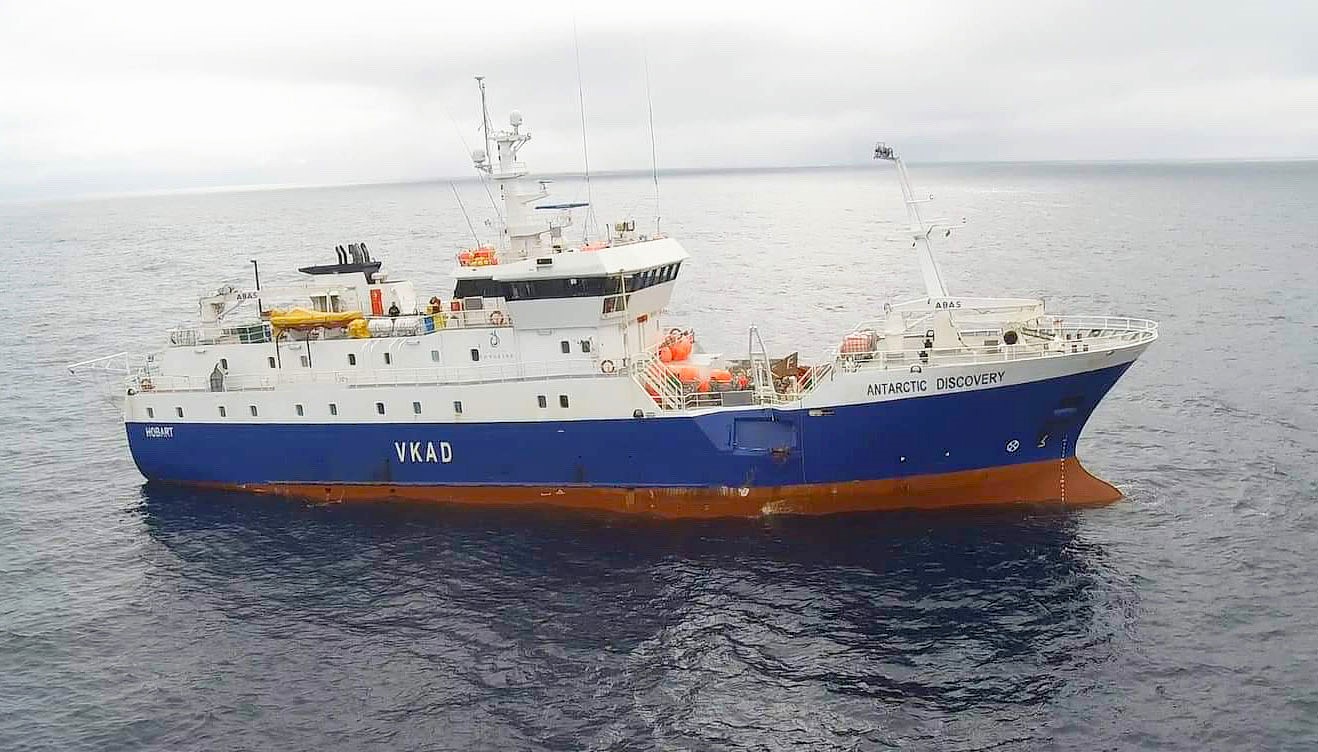
Four crewmembers were hospitalised after decomposing fish offal was accidentally pumped into a machinery space on board FV Antarctic Discovery, according to the Transport Accident Investigation Commission of New Zealand (TAIC).
The investigation report identified four systemic safety issues involving machinery isolation, confined-space hazards, coordination between multiple organisations, and oversight of safety-critical modifications.
What happened
On 21 February 2025, during maintenance in the Lyttelton dry dock, the longline fishing vessel Antarctic Discovery experienced a serious incident on board, involving hydrogen sulphide (H₂S) poisoning.
Two apprentice fitters entered the vessel’s bow thruster room to reinstall pipework. While working, contaminated water began discharging from a flexible red hose that was tied at the entrance to the bow thruster room. The hose was temporarily attached to the discharge side of the offal pump. The pump had been accidentally started and was drawing seawater from the forepeak tank (the extreme forward lower tank usually used for trimming or storage in a ship), which had been previously used to store offal. The contaminated water from the red hose was discharging down into the bow thruster room.
The apprentices escaped and alerted the crew. Responding to the incident, the vessel’s superintendent was briefly overcome by toxic H₂S gas while attempting to enter the forecastle but managed to retreat. The chief engineer and second engineer entered the forecastle through another entrance to investigate the source of the liquid and simultaneously collapsed. The second engineer regained sufficient consciousness to crawl to safety. The superintendent and second mate donned breathing apparatus and rescued the chief engineer. All affected personnel were hospitalised with symptoms of H₂S exposure and later recovered.
Why it happened
It is about as likely as not that the offal pump started when one of the apprentice fitters accidentally pressed the unlabelled start button. Their workspace was directly adjacent to the control panel for the offal pump. Without warning, contaminated water containing decomposing offal was pumped into the forecastle, releasing H₂S gas into a confined area with poor ventilation.
The Commission found that a combination of procedural failures, design shortcomings and inadequate oversight contributed to the accident. The offal pump had not been isolated nor locked and tagged out, leaving it active during maintenance. The forepeak suction valve remained open and the temporary flexible red hose, installed after a previous valve failure, was not capped.
The bow thruster room had many of the characteristics associated with an enclosed and confined space but had not been identified as such, meaning the risk assessment for work permitted in the space was not in line with good industry practice.
Wider safety issues
While the investigation found the immediate cause of the accident was the accidental starting of an offal pump, it also found four broader safety issues that affect industries well beyond the marine sector.
Acting Chief Investigator of Accidents Tahlia Fisher said: “First, it’s essential that before work begins all machinery be made safe – and that includes not just the equipment being worked on, but also nearby systems that could create danger if activated.
“Also, if a space has the hazards or characteristics of an enclosed or confined space, manage it as such, regardless of what it is called. In this case, the bow thruster machinery space had the hazards and characteristics of an enclosed or confined space but hadn’t been recognised and managed as one.
“And where multiple organisations are operating in the same workplace, there will be overlapping responsibilities, and safety depends on active coordination between everyone working on site.
“Finally, a point for senior managers and leaders is that safety-critical modifications need proper oversight with formal approval, documentation and oversight.”
Acknowledging extensive safety actions already taken by Antarctic Discovery’s owner, Australian Longline Pty. Ltd., the Commission made recommendations to Australian Longline and Lyttelton Port Company to strengthen management of safety-critical systems and dry dock operations.
Read the full report: TAIC MO-2025-201 – FV Antarctic Discovery